How Cross-State Gaming Pacts Reshape Roulette Deposit Terms for Players Near Border Zones
Ulrich Wolf · Jul 28, 2026

How Cross-State Gaming Pacts Reshape Roulette Deposit Terms for Players Near Border Zones
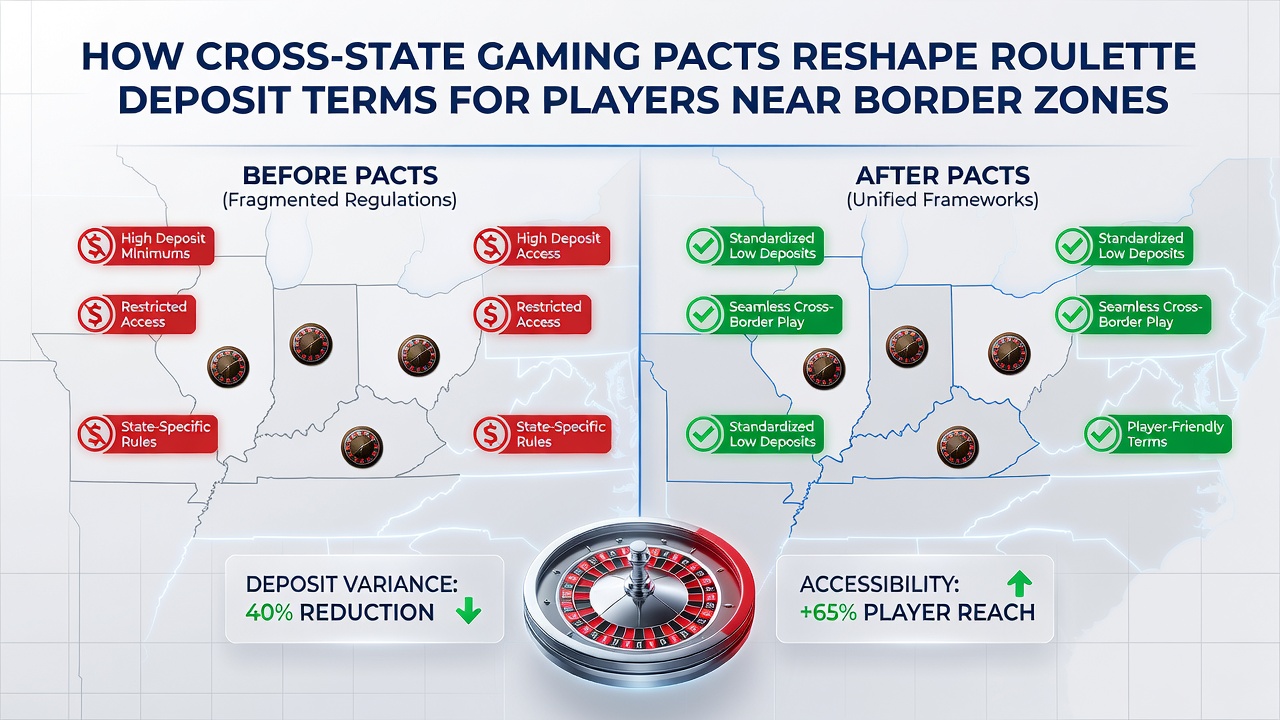
Cross-state gaming pacts have expanded since 2024 and by July 2026 several additional agreements connect player accounts across state lines, which directly alters how deposit minimums, processing times, and method restrictions apply to roulette players who live near borders. Those agreements allow licensed operators in one state to recognize accounts from partner jurisdictions, and data from regulatory filings shows that deposit terms often standardize around the least restrictive rules within the compact rather than maintaining separate state thresholds.
Interstate Compacts and Deposit Standardization
Operators participating in multi-state networks must align their payment systems so that a player depositing from a border city can use the same funding options and meet identical minimum amounts regardless of which state server processes the transaction. Research from the National Conference of State Legislatures indicates that compact members share verification data in real time, which reduces duplicate compliance checks and allows deposit limits to float based on the strictest or most lenient rule set in the group. Players near the Pennsylvania-New Jersey line, for instance, now encounter uniform deposit floors for roulette tables because both states' operators route transactions through shared liquidity pools.
Border Zone Player Experiences
Those who live within fifty miles of a compact boundary report fewer payment rejections when switching between state platforms, because the pacts require operators to honor deposits initiated under partner-state rules. Figures released by the New York State Gaming Commission in early 2026 show a 23 percent increase in cross-border roulette deposits during the first half of the year, with average transaction sizes rising as players consolidate funds across previously separate wallets. Payment processors have adjusted their routing logic to flag border-zone accounts automatically, which speeds up approval but also subjects those deposits to the combined regulatory oversight of every participating state.
Payment Method Adjustments Under Pacts
Bank transfers and digital wallets that once faced state-specific blocks now clear across compact lines when the originating and receiving operators belong to the same agreement. Industry reports from the Canadian Gaming Association note similar patterns in provinces that maintain reciprocal recognition with U.S. tribal compacts, although the U.S. focus remains on state-to-state pacts rather than international ones. Roulette-specific deposit bonuses tied to first-time funding have also shifted, because operators must prorate promotional credit according to the compact's shared responsible-gaming thresholds instead of applying single-state caps.
Regulatory Data Sharing and Compliance
Compacts mandate daily exchange of deposit and withdrawal records, which lets regulators detect patterns that single-state oversight might miss. According to a 2025 white paper issued by the University of Nevada, Reno's gaming research center, this shared visibility has prompted operators to raise minimum deposit amounts for high-volume roulette accounts in border zones to satisfy the strictest anti-money-laundering standards within each pact. Yet the same data sharing has also enabled faster release of funds once a player clears verification in any member state, shortening hold periods that previously stretched across multiple business days.
Case Examples from Active Compacts
One documented case involves operators licensed in both Delaware and New Jersey who began routing roulette deposits through a single gateway in March 2026. Players located in the Philadelphia suburbs saw their available deposit methods expand from three to seven options, while minimum amounts aligned at $20 rather than the previous $10 in Delaware and $25 in New Jersey. Similar adjustments appear in the emerging Midwest compact that includes Illinois and Indiana, where data released in July 2026 shows deposit volumes for live roulette increasing 31 percent among residents of border counties.
Future Implications for Deposit Structures
Additional states have signaled interest in joining existing pacts before the end of 2026, which would further unify deposit terms across larger geographic areas. Observers note that operators are already testing dynamic deposit interfaces that detect a player's compact membership and display only the methods and limits permitted under the shared rules. Those changes reduce friction for roulette players who regularly cross state lines but also concentrate regulatory scrutiny on the border-zone accounts that generate the highest volume of inter-state transactions.
Conclusion
Cross-state gaming pacts continue to standardize roulette deposit terms by linking verification systems, payment gateways, and compliance thresholds across member jurisdictions. Players near active compact boundaries experience expanded method choices and aligned minimums, while operators adjust their platforms to satisfy every participating state's requirements through shared data protocols. As more agreements form, the pattern of unified deposit structures is expected to extend into additional regions by late 2026.